Shirahama Workation from Tokyo: Coworking and Flights
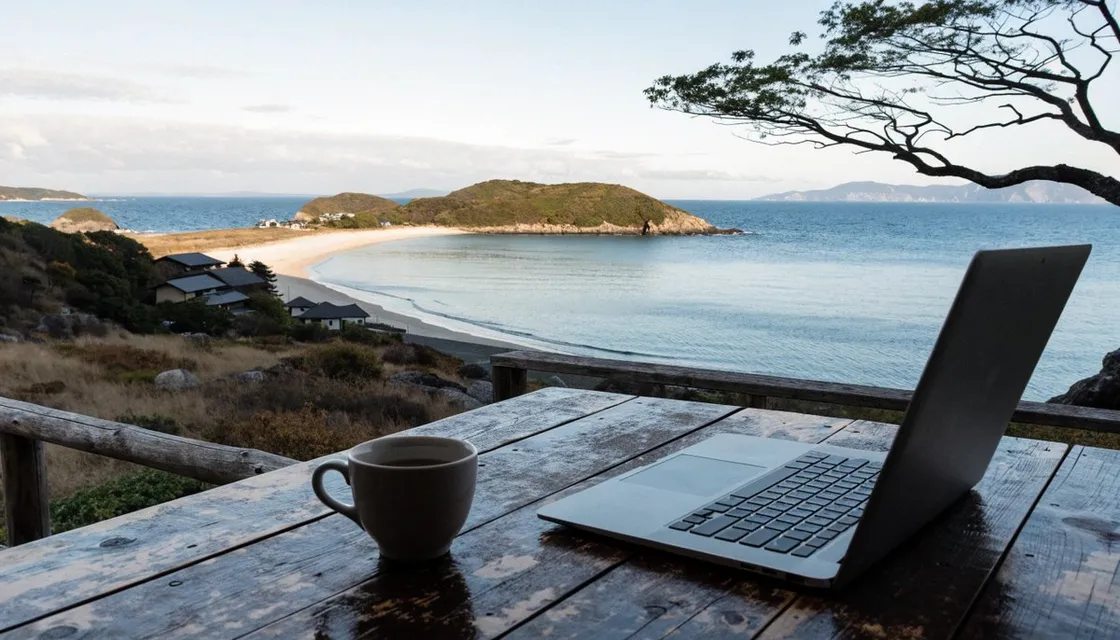
If you want a real workation from Tokyo, and not just a laptop in a hotel room, Shirahama in Wakayama is one of the stronger options near Tokyo by air.
The flight from Haneda is about 70 minutes. There’s a coworking space a short walk from the airport terminal. And the hot springs are close enough to reach after your last call.
The catch is that a popular piece of older advice is out of date, so it’s worth planning from current information.
Why Shirahama works for working
Shirahama didn’t become a remote work town by accident.
The town opened its IT Business Office in 2003, turning a former corporate retreat near the airport into office space. According to the Japan Tourism Agency’s case study, Salesforce’s arrival was the turning point. Other IT firms followed, and the town went on to open second and third offices.
The same study puts the town’s tourism at over 3 million visitors a year.
That combination is the point. You get a resort town’s hotels and restaurants, plus a town that has been courting IT companies since 2003.
The desk comes first. The sea is what you get for finishing.
Getting there from Tokyo
The fast route is JAL from Haneda to Nanki-Shirahama Airport. Booking sites list about 1 hour 10 minutes in the air and around three flights a day, but schedules change by season, so check JAL before you plan your calls around it.
With so few flights, the timetable shapes the trip. Pick your flights first, then build the work plan around them.
From the airport, the Shirahama hot spring area is about a 10-minute bus ride, according to the Japan National Tourism Organization.
Prefer rails? Shin-Osaka to Shirahama takes about 2.5 hours by limited express, which makes sense if you’re combining the trip with Kansai. From Tokyo it’s a long day, though the Shinkansen S Work Car can give you a desk for the first leg.
Where to work
Office Cloud 9 is the easiest place to start. It’s about five minutes on foot from the airport, and its Instabase listing mentions a free shuttle on request (about one minute). The Wakayama workspace guide lists soundproof booths, meeting rooms, English-speaking staff and views of the Pacific and the runway.
Its open coworking space is listed on the booking site Instabase at around ¥600 an hour or ¥1,800 a day, with fiber internet. The same listing asks for bookings at least six hours ahead, so don’t count on walking in straight off the plane. The listing doesn’t state opening hours, and prices and rules can change, so confirm hours, especially on weekends, before you go.
ANCHOR is a satellite office building with a coworking space, meeting rooms and a rooftop terrace, within walking distance of the Shirahama coast. It’s the more community-minded of the two, and the same guide says it hosts regular events.
We couldn’t confirm whether individuals can drop in, so contact them first.
Your room. Many stays list Wi-Fi, but a listing tells you nothing about speed or how a video call will behave. Guest Living Mu Nanki-Shirahama, for example, lists Wi-Fi and a working space on HafH, without speed details, and its rooms showed as unavailable when we checked.
If calls are your job, treat the coworking desk as primary and the hotel as backup. Ask the property about its internet before you book.
One thing older guides get wrong
Search for Shirahama workations and you’ll still find Mitsubishi Estate’s WORK×ation Site Nanki-Shirahama recommended everywhere.
It has closed. Business Insider Japan reported in October 2025 that the Shirahama site ended operations in 2025, and that Mitsubishi Estate was leaving the workation business, with the service ending that November.
Any guide built around it is working from old information. Check that a facility is still open before you plan your week around it.
A realistic four-day plan
The trick is not to treat this as a holiday with some email attached. Fix your working hours, then let the town fill the rest.
Thursday: take a morning flight, book a desk near the airport, and work the afternoon there. Then head to your hotel by bus.
Friday: a full working day. If you want the sunset at Engetsu Island, check that day’s time. In midwinter it falls around 5 p.m., so plan to wrap up a little early.
Saturday: the day off. Soak at Saki-no-Yu, the seaside open-air bath, walk Shirara Beach (about 620 meters of white sand), and see the Sandanbeki cliffs.
Sunday: a slow morning, then the flight home.
Meiko Bus runs a free-ride ticket for the local lines around Shirahama Station, though express buses are excluded. Check their site for current details before relying on it, because bus frequency is lower than you’d be used to in Tokyo.
Is it worth it over somewhere closer?
It depends on what you need from the trip.
For one day of fresh air, Atami or Karuizawa are simpler. No flights to book, no timetable to plan around.
Shirahama earns its effort when you want three days or more, a proper desk, and a sense of actually being somewhere else. The distance is part of what makes it work.
FAQ
Can you do Shirahama from Tokyo in a weekend?
Yes, if the flight times suit you. But it works better with at least one weekday, so you can use the coworking spaces and miss the weekend crowds.
Is the internet good enough for video calls?
Office Cloud 9 lists fiber on its booking page. Hotels vary widely, so ask each one directly, and keep a mobile data plan as backup.
When is the best time to go?
Summer is beach season and likely the busiest. Autumn and winter suit a working trip better: hot springs feel right, and it’s easier to keep your head down.