Tsukiji and Toyosu: A Morning Market Guide for Remote Workers
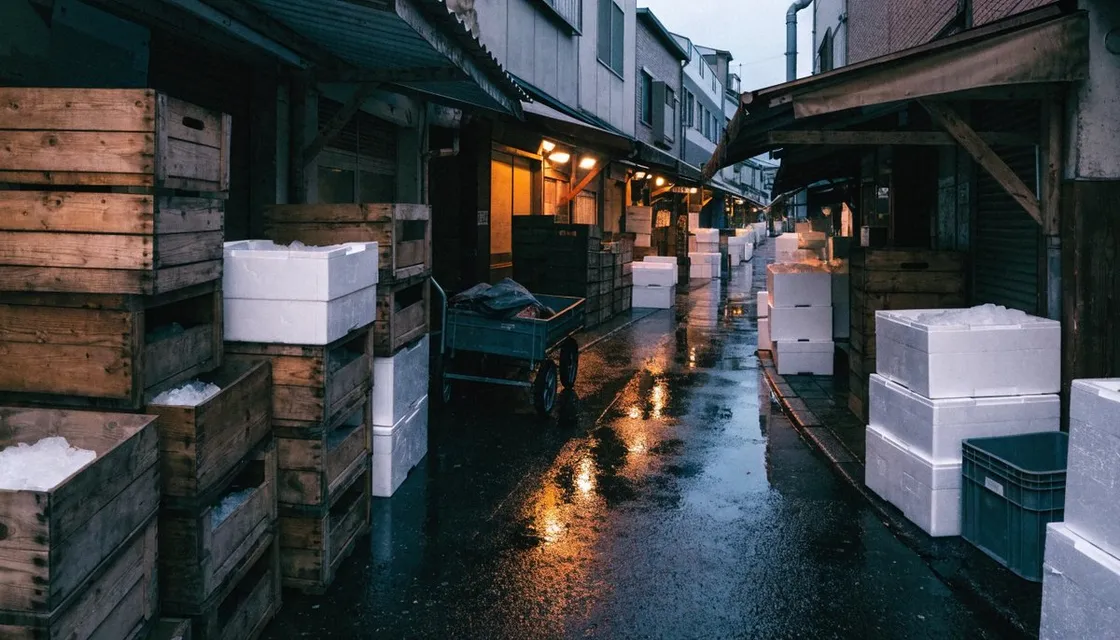
If you are awake at half past four and annoyed about it, Tokyo has somewhere for you to go.
Jet lag is usually treated as a problem to be fixed. For the first few days after a long flight west, it is also a free pass to the one part of the city that is fully alive before dawn.
The catch is that most visitors go to the wrong place, at the wrong time, on a day when everything is shut. So here is the map.
The market opens for the people who work in it. Everyone else is a guest of the schedule.
There are two markets, and they are not interchangeable
This is the single thing worth getting straight before you set an alarm.
Until 2018, the wholesale fish market and the little shopping streets around it were both at Tsukiji. Then the wholesale operation moved to a purpose-built facility at Toyosu, across the water.
What stayed behind is the Tsukiji Outer Market, the tangle of shops, stalls, and small restaurants that once served the trade and now mostly serves everyone else. It is still there, still busy, and still very good.
What moved is the actual market: the pallets, the forklifts, the tuna auction, the traders in rubber boots. That is Toyosu now.
So the choice is not which one is better. It is which morning you want. Toyosu is the working machine behind glass. Tsukiji is breakfast on foot.
Toyosu: go if you want to see the work
Toyosu Market sits on a reclaimed island in Koto ward, reached by the Yurikamome line to Shijo-mae. The line runs from Shimbashi, or you can pick it up at Toyosu on the Yurakucho line.
The building is enormous and, honestly, not charming. It is a food-safety facility, all corridors and sealed windows. That is the point: you are watching from walkways above the floor rather than standing in it.
The tuna auction is the headline. It happens very early, roughly in the five-to-six-thirty range, and there are two ways to see it. There is an upper viewing corridor you can simply walk into, and a smaller observation deck closer to the floor that requires applying in advance, typically by a lottery on the market’s official site. Slots are limited and demand is high, so treat the close-up view as a bonus rather than a plan.
The restaurant blocks are the part nobody warns you about, in a good way. Several dozen small places are tucked into the market buildings, opening around five in the morning and winding down by early afternoon. Queues at the famous sushi counters can be long before seven. Walk past the first three and the fourth will be excellent.
Next door is Toyosu Senkyaku Banrai, a newer complex with a food street on the ground floors and a hot-spring bath upstairs. A market morning followed by a soak and then a nap is an unreasonably good use of a Tuesday.
Tsukiji: go if you want breakfast and a walk
The Outer Market is the easier trip and the better one if you only have one early morning to spend.
Get off at Tsukiji on the Hibiya line, or Tsukijishijo on the Oedo line. Then just wander. The grid of lanes is small enough that getting lost is not really possible, and dense enough that you will still find something you missed.
What is actually there: knife shops that will sharpen a blade while you wait, dried bonito sold by the block, tamagoyaki cooked on the street and handed to you on a stick, sea urchin in trays, tea sellers, pickle sellers, and a great many places doing a seafood rice bowl for breakfast.
Arrive between six and eight if you want the working atmosphere. By ten it is a tourist street, still pleasant, but a different thing.
One piece of etiquette that matters more here than elsewhere in Tokyo. These are narrow lanes with carts moving through them. Step to the side before you stop to photograph anything, and do not eat while walking in the middle of the aisle. There are usually designated spots to stand and eat near the stalls that sell food.
The part that makes it a work morning, not just a tourist morning
Here is where the market trip stops being a nice thing you did and starts being a genuinely efficient use of a day.
Both markets are near good places to sit down afterwards.
From Tsukiji, it is a short walk to Hamarikyu Gardens, a walled Edo-era garden on the water with a teahouse in the middle of a pond. Ginza is ten minutes north on foot, which means every major coffee chain and a lot of quiet hotel lobbies. If you need a proper desk, Shiodome and Shimbashi are the next stops over and full of them.
From Toyosu, walk back toward Toyosu station and you are at a large waterfront mall with cafés, seating, and reliable power. It is not atmospheric, but it is comfortable, uncrowded on weekday mornings, and the view of the bay is better than your apartment’s.
Either way the shape of the day is the same. You have eaten properly, walked two kilometres, and seen something real, and it is only half past eight. The work that follows tends to go well.
Check the calendar before you set the alarm
This is the mistake that ruins market mornings, and it is entirely avoidable.
Both markets close regularly. Sundays and national holidays are almost always closed, and most Wednesdays are too, though which Wednesdays varies month to month. The New Year period closes everything for several days.
The wholesale market publishes its calendar in advance on its official site, and it is the authoritative source. Outer Market shops set their own hours and many follow the wholesale calendar out of habit.
Check the day before. A closed market at six in the morning in the rain is a specific kind of disappointment.
FAQ
Do I need to book anything?
Only for the lower tuna auction observation deck at Toyosu, which uses an advance application. Everything else, including the upper viewing corridor and all the restaurants, is walk-in.
Is Tsukiji still worth visiting now that the wholesale market has gone?
Yes. The Outer Market was always a separate thing, and it did not lose its shops when the wholesale trade moved. If anything the lanes are easier to walk now.
How early is early enough?
For the Toyosu auction, before six. For Toyosu restaurants, before seven if you want a short queue. For the Tsukiji Outer Market, anywhere from six to eight is the sweet spot. After nine it is still open, just busier and less interesting.