Typhoon Season in Tokyo: What Remote Workers Should Actually Do
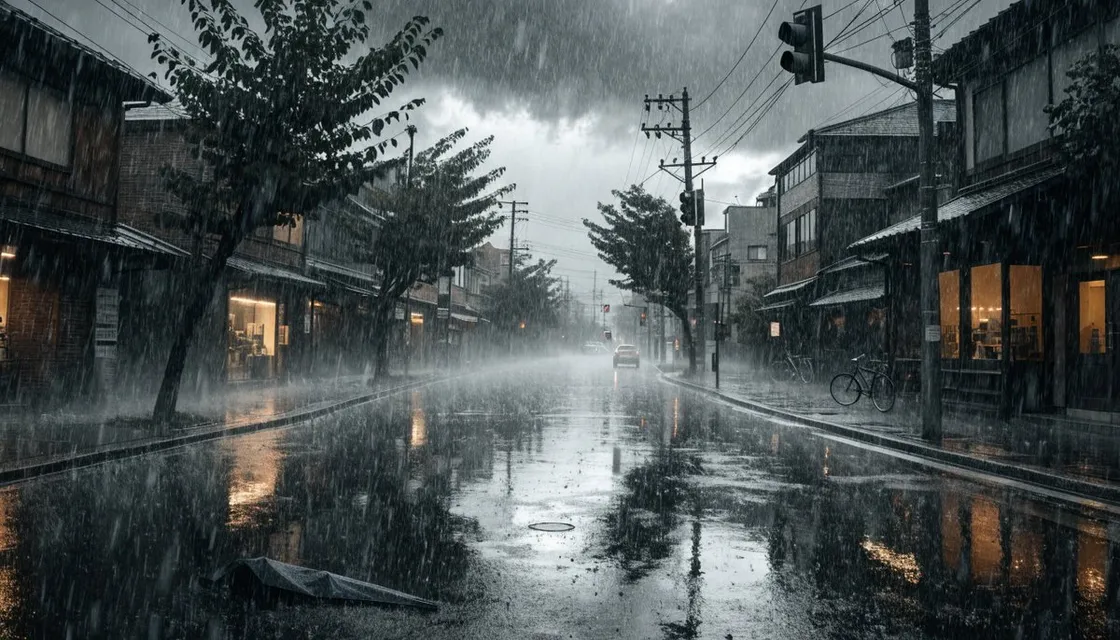
The short version: a typhoon rarely damages Tokyo in the way the word suggests, but it will reliably delete your ability to move around the city for about a day.
For a remote worker, that is the real risk. Not the wind, but the meeting you cannot get to, the coworking day you already paid for, and the flight that quietly disappears.
Nomads who treat typhoon season as a logistics problem, rather than a safety drama, tend to sail through it.
Tokyo’s typhoon window runs roughly from August into October, with September usually the busiest month. Storms form far to the south, then travel north over several days, which is the most useful fact in this entire article.
You almost always get warning. Often three or four days of it.
The city gives you notice. The mistake is treating that notice as background noise.
How to read the warnings without speaking Japanese
The Japan Meteorological Agency is the source everyone else is quoting, and it publishes in English. Its typhoon and warning pages are worth bookmarking before you need them.
The vocabulary matters more than the numbers. Japan uses a tiered system, and the tiers escalate in a predictable way.
An advisory is the mild tier: be aware, conditions may get unpleasant. A warning is the tier where trains start behaving strangely and outdoor plans should be reconsidered.
Since 29 May 2026, the agency has been adding a level number to warning names, for example “Level 3 heavy rain warning”, so they line up with the evacuation alert levels your ward issues. Level 4 is the point at which everyone in a danger area should evacuate.
Above that sits the emergency warning, which is rare and signals genuinely dangerous conditions. Do not wait for one before acting, and do not assume that staying inside is automatically the safe answer. Look up your address on the ward hazard map (the national Hazard Map Portal also works by address) while the storm is still days away, and follow your ward’s evacuation information. If your area is in a flood, storm surge or landslide zone, leave it by Level 4. Staying put is a choice for buildings, floors and hazards where it is actually safe, such as an upper floor of a sturdy building outside those zones. If an emergency warning is already out, moving may itself be dangerous, so take whatever action best protects your life at that point. Either way, stop optimising your day.
Your phone will also help whether you ask it to or not. Phones on Japanese networks receive government emergency alerts, which arrive with an alarming sound and no volume control. Whether a foreign eSIM or a roaming phone gets them depends on the handset and network, so also install Safety tips, the Japan Tourism Agency’s free alert app, which pushes earthquake, tsunami and weather warnings in English and 14 other languages.
That noise is not a malfunction. It is the system working.
The thing that actually stops your day: keikaku unkyu
The single most important concept is planned suspension, known as keikaku unkyu.
Rail operators now announce, usually a day or more in advance, that they will stop running certain lines from a certain hour. This is deliberate and it is not negotiable.
When it happens, the effect is total. Trains stop, stations close, and the city’s normal assumption that you can always get somewhere simply switches off.
Airport access is often affected first, because the lines to Narita and Haneda run through exposed coastal areas. Flights are frequently cancelled in advance too.
The practical rule is that you should check the operator’s site for your own line, not just general news. Announcements are line by line, and a suspension on one railway says nothing about another.
Once trains restart, they restart slowly and crowded. The morning after a big storm can be worse than the storm itself if you have somewhere to be.
What to do in the three days before
Treat the approach like a small project with a deadline.
Move anything location-dependent off the storm day. In-person meetings, viewings, appointments, and coworking day passes are all easier to reschedule two days out than two hours out.
If you have a flight in the window, watch the airline directly and take any free change they offer early. Waiting to see usually means competing with everyone else who also waited.
Buy food a day ahead rather than on the day. Konbini shelves in a storm-affected area thin out quickly, and deliveries pause when the roads and rails do.
Charge everything. Phone, laptop, battery pack, and anything else you would miss during a short outage.
Fill a bottle or two of water. Central Tokyo rarely loses supply, but it costs nothing to have.
Your apartment or hotel on the day
Bring in anything on a balcony. Laundry poles, plants, chairs, and drying racks become projectiles in strong wind, and this is the most common source of avoidable damage in a Tokyo building.
Close and lock windows properly, and shut any shutters if your place has them. Locking matters because it seats the window against the frame and reduces rattling and leaks.
Keep away from the glass during the peak hours. Sitting at a desk pushed against a large window is a perfectly normal thing to do on any other day of the year.
If you are in a basement or a low-lying area near a river, pay closer attention to flood advisories than to wind. Urban flash flooding from sudden intense rain is the more realistic hazard in much of the city.
Working through it
Most typhoon days in Tokyo are, honestly, quite productive if you set them up right.
Assume you will be indoors for a full day and plan work that suits that. Deep tasks, writing, admin backlogs, and anything you have been postponing because it needed uninterrupted hours.
Internet usually holds up. Fixed lines and mobile networks in central Tokyo are resilient, though heavy rain can degrade a connection briefly, so it is worth having mobile tethering as a backup before you need it.
Tell your team early if you are in the path. A short message the day before is far more professional than an apology mid-call, and international colleagues will generally have no idea what a planned suspension is.
If you are staying somewhere with thin walls, expect noise. Wind against a Tokyo apartment building is loud in a way that surprises people the first time.
After the storm passes
The air after a typhoon is often extraordinary. Clear skies, sharp light, and a temporary break in the humidity that makes late summer bearable.
Give the transport network a few hours before you rely on it. Check your line before you leave rather than after you arrive at the station.
Watch for debris and broken umbrellas on the streets, and be careful near rivers and canals for a day or so afterwards, since water levels stay high after the rain stops.
Then get on with your week. In most of Tokyo, most of the time, that is genuinely all a typhoon asks of you.
FAQ
Do I need to evacuate during a typhoon in Tokyo?
It depends on exactly where you are staying, not on the storm’s headline strength. Evacuation guidance is issued by your local ward or city for specific areas, usually those at risk of flooding, storm surge or landslides. Check your address on the ward hazard map before the season starts. If it falls inside a risk zone, or you are in a basement or ground-floor unit near a river, plan where you would go and leave by Level 4. If it does not, and the building is sturdy, staying inside away from windows is usually the sensible choice.
Will my trains and flights definitely be cancelled?
Not definitely, but assume disruption is possible and check the specific operator. Rail companies announce planned suspensions in advance, and airlines often waive change fees when a storm is forecast, so acting early costs you very little.
Is it safe to go outside and look at it?
It is a bad idea during the peak. Flying debris, unstable footing, and sudden gusts around tall buildings are the main hazards, and the storm is far less photogenic in person than it looks from a window.