Yokohama: The Day Trip That Doesn't Cost You a Workday
Most day trips from Tokyo ask you to sacrifice a whole day. Yokohama doesn’t.
It sits roughly half an hour from Shibuya on a direct train, which means you can close your laptop at two in the afternoon and be walking beside the sea by three.
That proximity is the entire argument. A trip you can decide on at lunchtime is a trip you’ll actually take.
Yokohama is Japan’s second-largest city by population, and it does not feel like a suburb of Tokyo. It feels like somewhere with its own weather.
Getting there is almost embarrassingly easy
From Shibuya, the Tokyu Toyoko Line runs through to Yokohama and continues onto the Minatomirai Line without you changing trains. Ride it to Minatomirai or Motomachi-Chukagai depending on which half of the city you want.
From Tokyo Station, JR lines head south to Yokohama Station in a similar window.
Your IC card covers all of it. No reservation, no seat assignment, nothing to organize the night before.
Skip Yokohama Station itself unless you need to shop. The station is a large commercial complex and looks like every other large commercial complex in Japan. The city you came for starts one or two stops further along.
The best day trip is the one with no logistics attached to it.
Three versions of the same city
Trying to see all of Yokohama in an afternoon is how people come home tired and vaguely disappointed. Pick one of these instead.
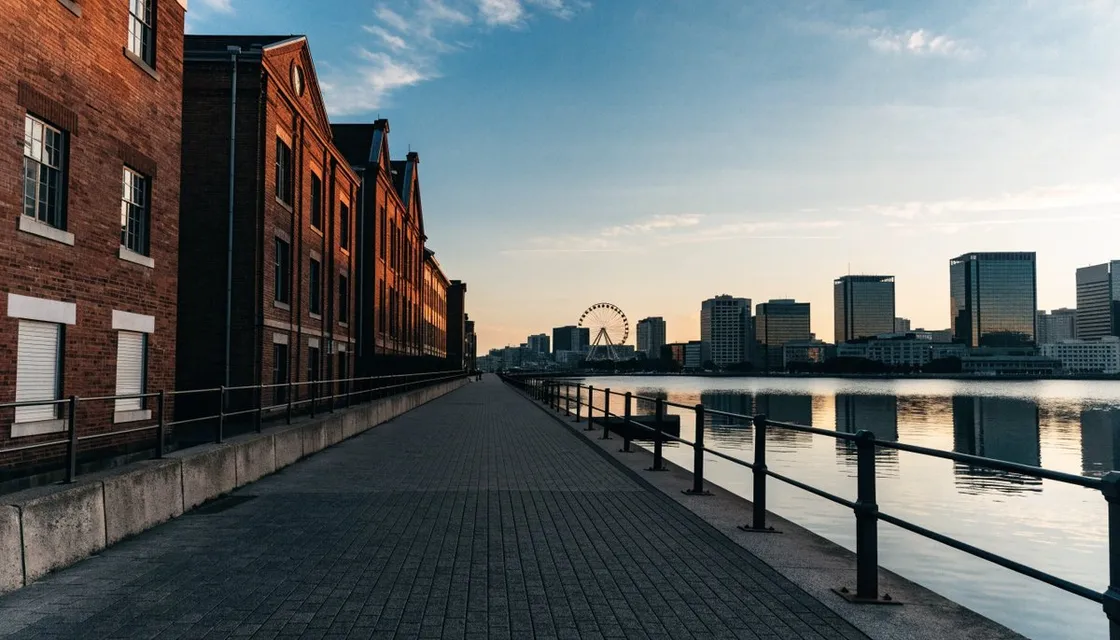
The waterfront. Get off at Minatomirai and walk toward the water. This is the postcard version: glass towers, a ferris wheel, wide open promenades, and the red brick warehouses at Akarenga that were rebuilt as shops and event space.
What makes it worth the trip isn’t any single building. It’s the space. Tokyo rarely gives you a horizon, and here you get one, plus a breeze off the harbor.
Rinko Park and the paths around it are flat, quiet on weekdays, and pleasant to walk slowly.
The harbor and Chinatown. Get off at Motomachi-Chukagai instead. Yamashita Park runs along the water, Chinatown sits just behind it, and Motomachi is the small shopping street on the hill.
Yokohama’s Chinatown is one of the largest in the world and is genuinely a place people eat rather than a photo backdrop. Steamed buns from a street window are the low-effort version. Sitting down somewhere for a proper meal is the better one.
Noge, after dark. Inland from the waterfront, near Sakuragicho, is a dense grid of tiny bars and standing counters. It is older, scruffier, and much cheaper than the harbor side.
If the polished waterfront starts feeling like a shopping mall with a view, walk fifteen minutes inland and the city changes character completely.
Sankeien, if you want the quiet version
Further out toward Honmoku is Sankeien, a large Japanese garden built around relocated historic buildings, with ponds, a pagoda on a hill, and walking paths.
It takes a bus or a bit of planning to reach, which is exactly why it stays calm.
Go here if what you actually want from the day is silence rather than sightseeing. Autumn afternoons are especially good for it.
Working from Yokohama for half a day
You can treat this as a change of desk rather than a break from work.
The Minato Mirai area has plenty of chain cafes with power and stable connections, and the district is built around open public space, so finding somewhere to sit outdoors between calls is easier than in central Tokyo.
Yokohama also has a well-regarded central library and several public facilities near the waterfront, which are worth checking before you go if you need a quiet block of focused time.
One honest caveat: cafes near the water fill up on weekends and during school holidays. A Tuesday morning is a different experience from a Sunday afternoon.
Tokyo teaches you to work in small spaces. Yokohama reminds you that you don’t have to.
Timing it well
September through November is arguably the best stretch of the year for this. The heat lets go, the harbor wind stops being punishing, and the light in the late afternoon over the water is very good.
Winter is clear and cold, and the waterfront is exposed, so bring more layers than Tokyo would require.
Summer afternoons on the promenade are hot with very little shade. If you go in August, go early or go at sunset.
The thing that makes it repeatable
Kamakura is a reset. Hakone is a trip. Yokohama is neither, and that’s the point.
Because it costs you almost nothing in travel time or planning, you can go more than once. Do the waterfront in September, Chinatown when it turns cold, Noge on an evening when you’re tired of your own neighborhood.
There is no last-train anxiety either. Trains back to central Tokyo run late, so an afternoon can drift into an evening without any decision required.
FAQ
Do I need a JR Pass or any special ticket?
No. A regular IC card works on all the routes above, and the fares are modest. Special tickets exist for tourists but rarely pay off for a single day trip from Tokyo.
Is one day enough?
For one of the three areas above, yes, comfortably. For all of them, no. Yokohama rewards a narrow plan far more than a complete one.
Is it worth going if I’ve already done Kamakura?
They do different jobs. Kamakura is temples, hills and a slower town. Yokohama is a working port city with a waterfront and a strong food scene. Neither replaces the other.