Jimbocho: Working a Day in Tokyo's Book Town
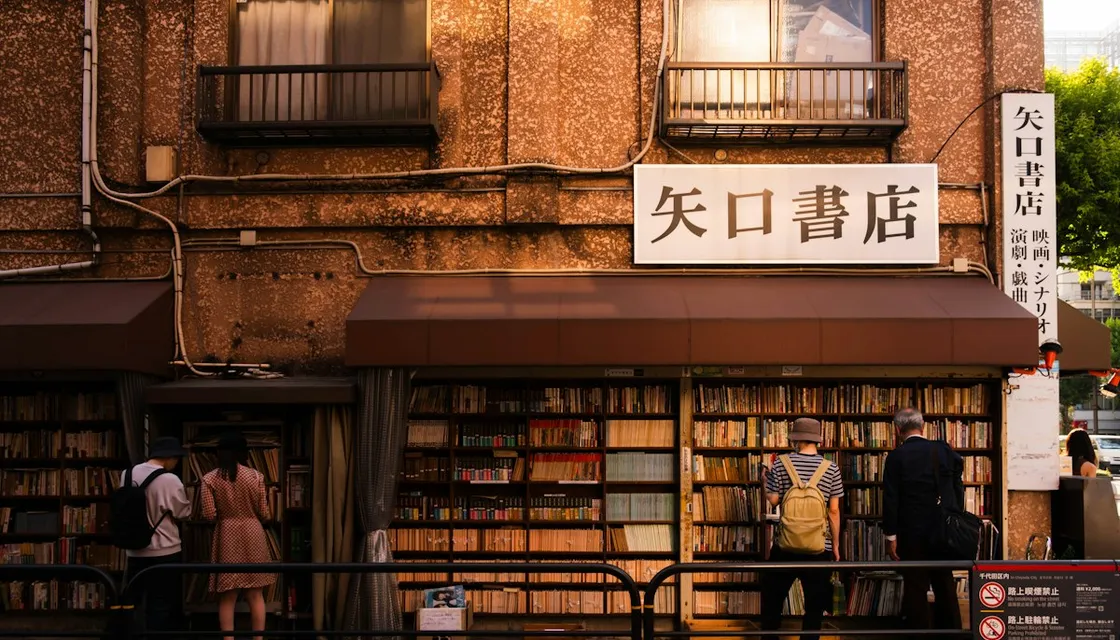
If you have one day where the work is thinking work rather than meeting work, spend it in Jimbocho.
It is a ten-minute ride from most of central Tokyo, it costs almost nothing, and it is built around the two things a remote worker actually needs on a hard day: somewhere to sit for a long time, and something to look at that is not a screen.
Jimbocho is Tokyo’s secondhand book district. Roughly a hundred and fifty bookshops sit within a few blocks of the crossing, which makes it one of the largest concentrations of used bookstores anywhere in the world.
But the reason it works as a workday is less about the books than about the pace. Nobody here is in a hurry.
A neighborhood that sells old paper cannot be rushed, and that quality rubs off on whoever is sitting in it.
Getting there and getting oriented
Jimbocho station sits on three lines: the Hanzomon, the Toei Shinjuku, and the Toei Mita. From Shibuya, Shinjuku, or Otemachi you are looking at a short ride with no transfer for most people.
The district organizes itself around the Jimbocho crossing and Yasukuni-dori, the wide street running east to west. Shops line the south side of that street, which is not an accident: the awnings face north, so direct sun never falls on the stock.
Once you know that, the whole neighborhood reads differently. It was laid out to protect paper.
Walk east and you drift toward Ochanomizu and the guitar shops. Walk west and you reach Kitanomaru Park and the moat, which is one of the better places in central Tokyo to take a call while walking.
Where to actually open a laptop
The honest answer is that Jimbocho is a reading neighborhood more than a laptop neighborhood, and it pays to work with that rather than against it.
Some of the old kissaten here have been operating for decades, and a few are famously protective of their atmosphere. Assume a laptop is not welcome in a small, dark, twelve-seat coffee house unless you can see other people using one. Some of the older places are also cash only, so bring some.
The workable pattern is to split the day. Use a bookstore café or a chain coffee shop for the laptop hours, and save the classic kissaten for the break in between, phone away, notebook out.
Book House Cafe near the crossing is one of the friendlier options for sitting a while, and there are the usual larger chains along Yasukuni-dori if you need power and a table. Tokyodo Shoten, one of the big new-book stores in the area, spreads over three floors and is worth a browse between work blocks.
If you need guaranteed power and quiet for a video call, the more reliable move is to work in Otemachi or Kanda in the morning and come to Jimbocho after lunch. It is one stop.
The kissaten hour
This is the part worth planning your day around.
Jimbocho has several of the oldest surviving coffee houses in Tokyo, the kind with wood-panelled walls, thick ceramic cups, and a smell that has been settling into the furniture since before you were born.
Sabouru, with its slightly chaotic mountain-lodge interior, is the one most visitors have heard of. Ladrio nearby is often credited as one of the earlier places in Japan to serve Vienna coffee. Milonga Nueva plays tango and keeps an impressive lineup of imported beer.
Details change, so check current hours before you build an afternoon around any one of them. Many are closed on Sundays, and lines form at peak times.
What these places offer a remote worker is not wifi. It is a forty-minute stretch where the only reasonable thing to do is sit with your own thoughts, which is a scarcer resource than bandwidth.
Curry, because that is what Jimbocho eats
The neighborhood has an unusually deep curry culture, and locals take it seriously enough that the area hosts a curry festival most years.
Japanese-style curry here runs from thick European-influenced roux to sharper Indian and Nepali kitchens, often served at counters with a queue out the door around noon.
Eat early or eat late. Between roughly twelve and one, the whole district is students and office workers, and you will spend your patience standing rather than eating.
If you like a big lunch, plan a walk afterward rather than a deadline. Jimbocho curry is not a light meal.
What to bring home
You do not need to read Japanese to enjoy the shopping, though it obviously helps.
Kitazawa Bookstore has long been known for foreign-language and antiquarian books. Other shops specialize hard: film posters, ukiyo-e prints, architecture, mountaineering, sheet music, old maps.
Vintage prints and small ephemera are often more affordable than people expect, and they pack flat, which matters if you are living out of a suitcase.
If you happen to be in Tokyo in late autumn, the Kanda used book festival turns Yasukuni-dori into open-air shelves for several days. It is one of the more pleasant crowds in the city.
A realistic day
A shape that tends to work: arrive around ten with your heaviest task already chosen, take a table somewhere with power, and push through the morning while the neighborhood is still quiet.
Eat curry at eleven thirty, before the rush.
Spend an hour in the shops with your phone in your bag, then take the kissaten break and write by hand for whatever is stuck.
Return to a table for a final block in the late afternoon, then walk west to the moat as it gets dark.
That is a full day of work and a full day in Tokyo, and it costs less than most people spend on a coworking day pass.
FAQ
Is Jimbocho good for video calls?
Not especially. Cafés here are small and quiet, which makes calls awkward for everyone. Take calls outside while walking toward Kitanomaru Park, or book a nearby day-use room or coworking space if the call matters.
Do I need Japanese to shop here?
No. Prices are marked, browsing is expected, and many shops are used to visitors. A few phrases and a willingness to point will get you a long way.
When is the neighborhood at its best?
Weekday mornings are calm and most shops are open. Sundays are the weakest day, since a noticeable number of the older shops close. Late October to early November brings the book festival and much bigger crowds.