Yanaka for Remote Workers: Slow Streets, Long Focus, Old Tokyo
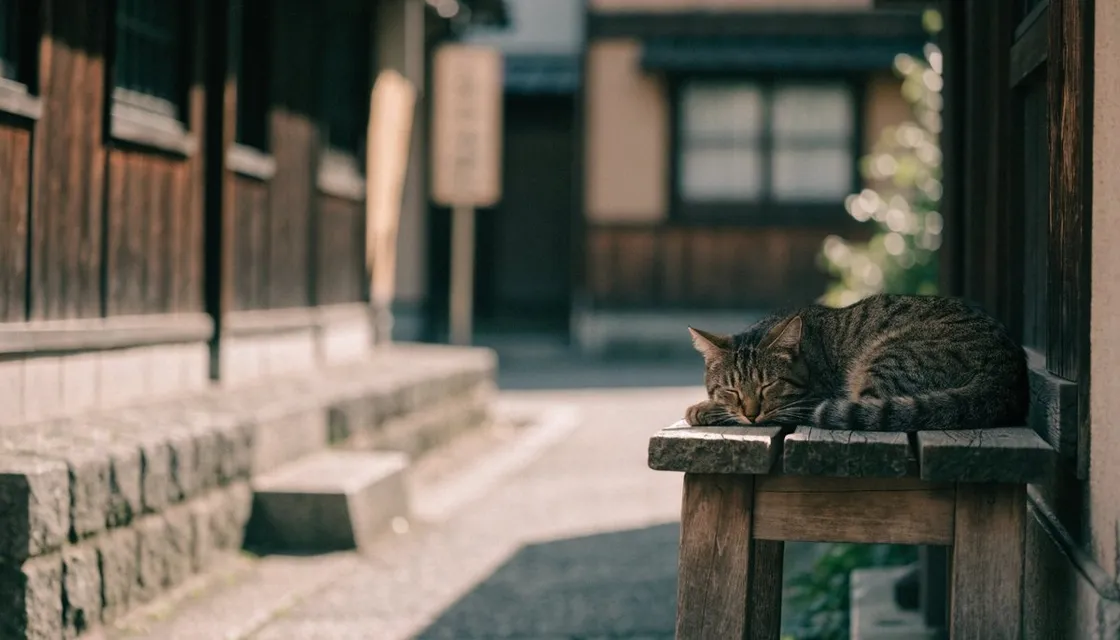
If the version of Tokyo you came for is the loud one, Yanaka will disappoint you. If you came to actually get work done, it may be the best trade in the city.
Yanaka sits in Taito ward, roughly between Nippori and Sendagi stations, on the northeastern edge of central Tokyo. It is a low-rise, temple-dense, cemetery-adjacent pocket that largely escaped both the wartime fires and the bubble-era rebuilding.
The practical consequence is a neighborhood where almost nothing is taller than four storeys, streets are too narrow for through traffic, and the ambient noise floor is closer to a small town than a capital city.
For remote work, that combination is worth more than it sounds.
Why the geography matters for focus
Most of Tokyo is organised around stations. You live near one, you work near one, and the density collapses the moment you walk five minutes away from it.
Yanaka inverts that. The interesting parts are the streets between the stations, not the concourses.
That means your daily radius is walked rather than ridden. Coffee, groceries, a park bench, a temple wall to sit against, all of it tends to fall inside a fifteen-minute loop on foot.
Anyone who has tried to hold deep focus across a day of train transfers will recognise the value. Fewer transitions, fewer decisions, less friction between one block of work and the next.
The city rewards you differently depending on what you ask of it. Ask Yanaka for stimulation and it shrugs. Ask it for room to think and it delivers.
What a working day tends to look like
The rhythm here is unusually forgiving of the split-day pattern that many remote workers end up on.
Mornings are genuinely quiet. Local cafes and kissaten open early enough for a focused first block, and they rarely fill up before mid-morning. The flip side is that many small owner-run shops close by early evening and take their own weekday off, so check a place’s hours before you plan a session around it.
Midday is when Yanaka Ginza, the shopping street running down from Nippori, gets busy with visitors and day-trippers. It is a good window to step away from the screen rather than fight for a table.
Late afternoon empties out again as the day crowds head back toward the stations. If your calls land on European or North American hours, the evening street noise here will not be the thing that ruins a call.
Cafes, kissaten, and where the wifi actually holds
Yanaka is rich in small independent cafes and old-style kissaten, and thin on large chain outlets with reliable power outlets.
That is a genuine trade-off, not a hidden perk. You should assume that many of the most charming places have limited seating, no outlets, and an unspoken expectation that you will not camp for four hours.
The workable pattern most people settle into is short, respectful sessions in local cafes, paired with a longer anchor session somewhere better equipped.
Nippori station is a short walk away and has chain cafes where a longer stay is more normal. Ueno is close too, but it is a transit hub rather than a laptop district, so do not count on a seat there after mid-morning; its park and museum cluster are better as a change of scene than as an office.
If your work needs guaranteed bandwidth and outlets for six hours a day, treat Yanaka as where you live and the surrounding stations as where you work. That split works well.
Living costs and housing feel
Yanaka reads as more affordable than the western hubs of similar convenience, though this is a neighborhood where the range is wide and the stock is old.
Expect a lot of older, smaller buildings, some genuinely charming, some simply old. Monthly apartment and share house listings do appear here, but inventory is thinner than in Shinjuku-adjacent areas, so booking further ahead helps.
The trade you are making is space and quiet against convenience and modernity. Fewer late-night options, fewer international conveniences, more actual residential life.
For a short stay of a few weeks, the shortage of nightlife may feel like a loss. For a stay measured in months, most people find it is the opposite.
The temples, the cemetery, and why nobody minds
Yanaka Cemetery is one of the largest green spaces in the area, and it functions as a park in daily life. People walk dogs there, cut through on the way to the station, and sit under the cherry trees in spring.
It is not treated as a solemn no-go zone, but it is still a cemetery. Quiet voices, no picnics on graves, no drone footage, and general restraint are the norm.
The density of temples in the surrounding streets has the same effect. Walls, gates, and old trees break up the sightlines and absorb noise in a way that ordinary Tokyo blocks do not.
Getting in and out
Nippori is the practical anchor. It sits on the Yamanote and Keihin-Tohoku lines, and it is also a Keisei Skyliner stop, which makes Narita Airport unusually straightforward from here.
Sendagi and Nezu on the Chiyoda line cover the western and southern edges, and Ueno is a short ride or a reasonable walk for shinkansen departures north.
For anyone who flies in and out of Narita frequently, the Skyliner access alone is a real argument for the area.
Who Yanaka suits, and who it does not
It suits writers, developers, researchers, and anyone whose work improves with fewer interruptions and a walkable daily loop.
It suits people staying a month or more, who benefit from a neighborhood that reveals itself slowly.
It suits nomads who have already done the Shibuya and Shinjuku version of Tokyo and want something different from a second or third visit.
It does not suit people who want a dense coworking scene on their doorstep, a busy after-hours social calendar, or a large pool of English-speaking service staff.
And it does not suit anyone who needs guaranteed workspace infrastructure within a two-minute walk at all times.
If you are still deciding where to base yourself, it is worth putting Yanaka next to the better-known areas in the Tokyo neighborhood comparison, which lines up seven central areas on cost, transport and workspace.
FAQ
Is Yanaka a realistic base, or just a nice day trip?
Both work, but it rewards the longer stay more. A half-day visit shows you the shopping street and the temples. A month shows you why the quiet matters.
Is there coworking in Yanaka itself?
The immediate area leans toward small cafes rather than dedicated coworking floors. Most people combine local cafes with the chain cafes around Nippori station, or a coworking space further into central Tokyo.
How much Japanese do you need here?
More than in Shibuya, less than you might fear. It is a residential neighborhood with many small owner-run businesses, so English is less common. Basic greetings, numbers, and a translation app cover most daily situations comfortably.