Sending and Receiving Packages in Tokyo: A Nomad's Guide to Takkyubin
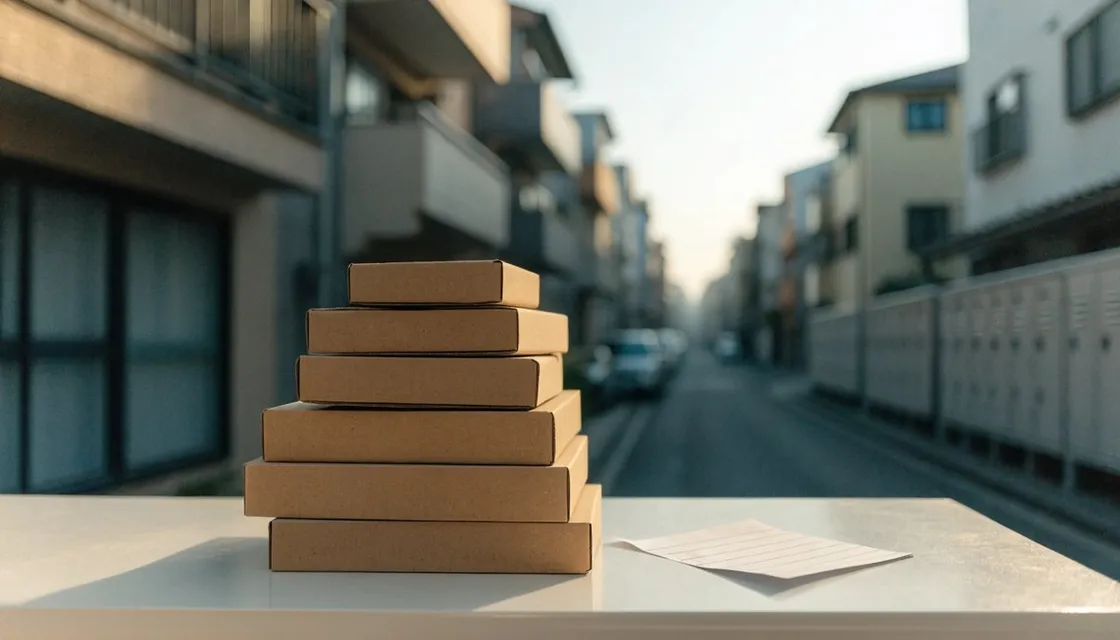
Here is the short version: in Tokyo you almost never need to carry your own luggage, wait at home for a courier, or worry about a package going missing.
The delivery system, known collectively as takkyubin, is fast, cheap by international standards, and built around the assumption that you will not be home.
For a nomad, that changes the shape of a week. You can ship a suitcase ahead of you to Kyoto, order a monitor to a convenience store, or return something without ever finding a post office.
The trick is knowing which of the four options fits your situation, and none of them require much Japanese.
Why this matters more when you have no fixed address
Most delivery advice for Japan assumes you live somewhere permanent, with a mailbox and a name plate on the door.
Nomads rarely have that. You might be in a share house for three weeks, a monthly apartment for two months, or a hotel for four nights.
That situation breaks the default assumption of home delivery, which is why the workarounds below matter. Once you know them, having no fixed address stops being an obstacle.
The city is built for people who are out. That turns out to be very good news if you never stay in one place for long.
The four ways to receive something
Delivery to your address. This works fine if you are staying somewhere for a while. Make sure the name you order under matches the name on the mailbox or intercom, because couriers do check. If you are in a share house, add your room number and confirm with the operator that packages are accepted.
Delivery lockers. Many apartment buildings, and increasingly train stations and convenience stores, have a bank of lockers called takuhaibokkusu. The courier leaves the parcel, you get a code, and you collect it whenever you like. This is the most nomad-friendly option in a building that has one.
Convenience store pickup. Major retailers, including Amazon and many Japanese shops, let you choose a nearby konbini as the delivery point. You show a barcode or a code at the counter and walk out with the box. This is the best option when your accommodation is uncertain, because a konbini does not care who you are or how long you have been in the country.
Redelivery. If you missed a delivery, a paper slip goes in your mailbox. Almost every carrier now accepts redelivery requests through a website or a LINE account, often in English, using the tracking number printed on the slip. Same-day redelivery is usually possible if you request it before the cutoff, which tends to be in the evening.
Sending things: how takkyubin actually works
You do not need a post office to send a domestic parcel.
Convenience stores accept takkyubin at the counter, which means you can ship something at two in the morning if that is when you finish work. Yamato, Sagawa, and Japan Post all run competing networks, and at the konbini counter it splits by chain: 7-Eleven and FamilyMart take Yamato, while Lawson, Ministop, and Seicomart take Japan Post’s Yu-Pack.
The process is simple. You fill in a paper form with the sender and recipient details, hand it over with the box, pay, and keep the receipt with the tracking number. If you would rather not handwrite Japanese, Yamato also lets you create the label and pay on your phone, then show a QR code at a 7-Eleven or FamilyMart counter. That route needs a free Kuroneko Members account.
Staff will weigh and measure the parcel for you. Prices depend on size and distance, and for a small box within the Tokyo area you should expect it to be quite affordable, while a large box across the country costs meaningfully more.
Cash always works. Many konbini also accept IC cards and QR payments for shipping, though this varies by chain.
From Tokyo, delivery is next-day to many regions, but not everywhere. Since June 2023 Yamato has added a day on some longer routes, including Kanto to Shikoku, so those now arrive two days after shipping. Do not count on same-day delivery for an ordinary parcel. If you are sending boxes ahead of yourself, check the date on Yamato’s delivery-date lookup before you ship. You can also choose a delivery time window, which is genuinely useful when the recipient is a hotel or a coworking space.
Luggage forwarding, the underused nomad hack
This is the feature most visitors never discover, and it is a quiet game changer if you travel with more than a backpack.
You can send your suitcase from your Tokyo accommodation directly to your next one, then travel across the country with only a day bag. Airports, major hotels, and many konbini all handle this.
Airport forwarding works in both directions. You can send bags from Narita or Haneda to a city address on arrival, or send them ahead to the airport before a flight out.
Plan for time. Same-day service exists on some short routes, but the safe assumption is next-day for nearby cities, two days for longer routes, and one to two days if an airport is involved. Booking a day earlier than you think you need costs nothing extra and removes the stress.
For anyone doing a working trip to Kyoto or Osaka, this pairs beautifully with the shinkansen. Your bag goes by truck, you go with a laptop and a coffee.
Small things worth knowing
Cold and frozen delivery, which Yamato calls Cool TA-Q-BIN, is widely used. It is how people send food gifts, and it is why ordering perishables online is normal here. Sending one yourself is the catch: Yamato accepts it only at its own offices or by driver pickup, not at konbini counters.
Returns are usually painless. Many Japanese retailers issue a prepaid slip you attach to the box before dropping it at a konbini.
International shipping is a different animal. Japan Post handles most outbound personal parcels, and for that you generally do need an actual post office, plus a customs form. Give yourself more time than domestic shipping would suggest.
Address format matters. Japanese addresses run from largest unit to smallest, and most online forms expect that order. If a form gives you separate fields, filling each one exactly as written on your accommodation confirmation avoids nearly all problems.
FAQ
Can I receive a package at a hotel or hostel?
Usually yes, especially at business hotels, but ask first and use the exact name on your booking. Some smaller guesthouses decline parcels, and almost none will hold something that arrives before your check-in date.
What if I do not speak Japanese at the konbini counter?
Very little conversation is needed. Handing over a filled-in form and a box communicates the whole request, and staff will point at the scale and the payment terminal. Having the destination address written down, ideally in Japanese, removes the last friction point.
Is it safe to have things delivered without being home?
Generally yes. Theft of parcels is rare, and lockers and konbini pickup both remove the risk entirely. If you are anxious about a valuable item, konbini pickup is the option to choose.
Tokyo’s delivery network rewards a small amount of setup knowledge with a lot of freedom.
Once you have used a konbini counter once and collected one package from a locker, the whole system stops feeling foreign and starts feeling like infrastructure you can lean on.