The Tokyo Silence Map
The first time Tokyo breaks your concentration, you might be standing in Shinjuku station trying to answer one email. Around you, hundreds of thousands of people move with the terrifying competence of a colony that’s evolved past the need for eye contact.
Announcements in three registers. A jingle for every departing train.
And somewhere, always, construction. It’s easy to put the phone away, email unanswered, and think: I can’t think here.
That frustration makes a good project. Forget mapping Tokyo by neighborhoods or stations, and map it by silence instead: the pockets where a nomad with a loud brain can actually hear themselves work.
It turns out to be one of the most useful maps you can have here.
A megacity doesn’t remove silence. It hides it, and rewards anyone patient enough to look.
Quiet cafés are rarer than you think
The obvious answer is the café. It won’t save you.
Tokyo’s cafés are wonderful, but people go there to be around other people. There’s music, the espresso machine, and the group at the next table rehearsing a presentation.
For shallow work, like email, admin, and the busywork that survives distraction, they’re fine. For thinking that needs an unbroken hour, they tend to let you down right when it counts.
So stop asking where the Wi-Fi is good. Ask a stranger question: where does this city keep its silence?
Shrines: quiet right in the busy city
Surprisingly often, the answer is a shrine.
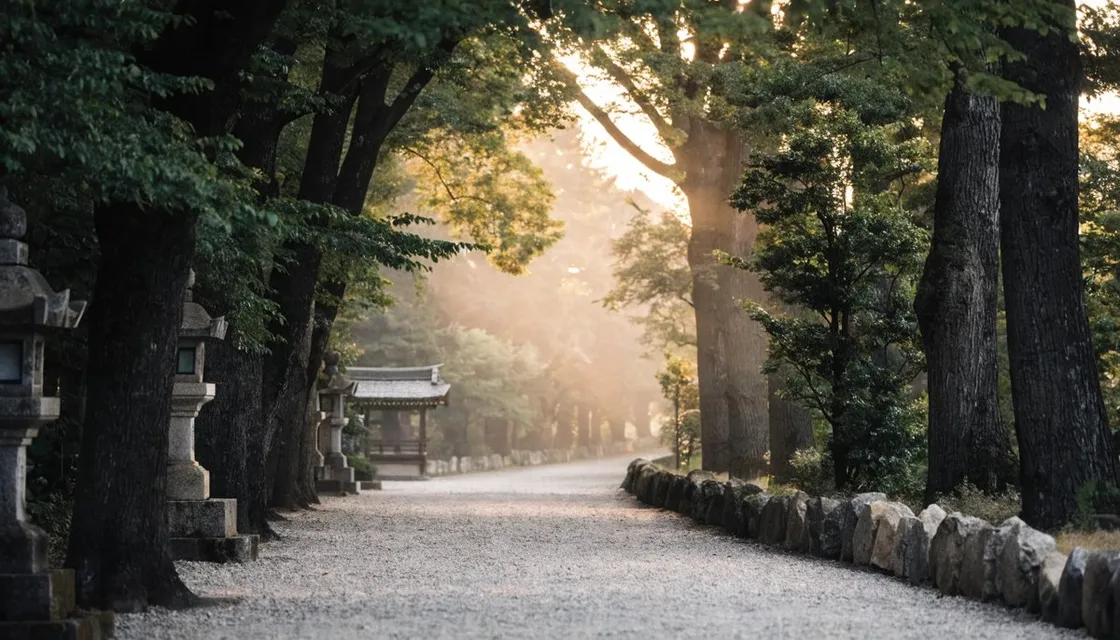
Meiji Shrine pulls off something no productivity app can. You step out of one of the busiest districts on earth, walk under a wooden gate, and within ninety seconds the city’s volume drops, like a heavy door swinging shut.
Gravel underfoot. Trees planted a century ago so that exactly this would happen.
The noise doesn’t really fade. It just goes, and something older and slower takes its place.
You can’t work there, and that’s the point: no desk, no outlet, no Wi-Fi. It’s a place to unclench.
Spend twenty minutes under those trees and the problem that wouldn’t budge at your desk often sorts itself out, the way problems do once you stop strangling them.
Tokyo is full of places like this. Small neighborhood shrines you’d walk right past, and gardens that charge a few hundred yen or less (Kiyosumi Teien in Koto ward asks 150 yen) and throw in a kind of silence money usually can’t buy.
Places built for quiet
Then there are places built for quiet, and Tokyo does those better than almost anywhere.
Ward libraries are free, air-conditioned, and keep the hush with an almost religious seriousness. People write whole proposals in district libraries, surrounded by retirees and students, everyone pretending nobody else exists and grateful for it. The catch for a visitor is getting in. Many ward libraries keep their study seats behind a library card and a booking terminal, and the card usually needs proof that you live, work or study in the ward. Check the library’s site for laptop-friendly seats before you plan a deadline day around one.
And then there’s the strangest gift of all: the listening bar. Tokyo has bars that exist so you can sit, stay quiet, and listen to records on a sound system worth more than a car.
Talking is discouraged, and phones are rude. You order a drink and give the music your full attention, which, it turns out, is something a lot of us have forgotten how to do.
A jazz kissa is one of the few places left where you can practice doing exactly one thing at a time.
What chasing silence does to your work
Here’s what surprises people. Hunting for quiet in Tokyo does more than help you focus.
It changes what you think focus is.
It’s tempting to think you can force concentration with more coffee and a better app. Tokyo suggests it’s more like a shy animal. You can’t summon it. You set up the right conditions and wait.
The shrine, the library, and the listening bar all work for the same reason. They take away the option of distraction, and then they take away the guilt of being unreachable.
You can’t add focus. You can only subtract everything that isn’t it.
A city this loud can make you quieter. Not exactly calmer, since Tokyo will never be calm, but better at finding the volume knob.
Build your own map of quiet places
If Tokyo’s noise is drowning you, a better café won’t fix it. Start collecting quiet places: a shrine near home for the mid-afternoon slump, a ward library for deadline days, and one listening bar for when you’ve forgotten how to do one thing at a time.
Map the silence, and this same city can become one of the most focused places you’ll ever work.